- Ningbo Dongning Tools Co.,Ltd
- Professional Chinese Tools manufacturer on automotive speciality tools,bearing puller&heavy truck tools
- Address
- No.6 Falan Rd,Hengjie Town,Ningbo City,Zhejiang,China
- Phone
- +86-574-87216625
- info@nbdntools.com

A bearing puller is a specialized automotive and industrial tool used to remove bearings, gears, pulleys, and other press-fit components from shafts or housings without damaging surrounding parts. Bearing pullers are widely used in automotive repair, gearbox maintenance, heavy truck service, and industrial machinery applications where components are tightly fitted and difficult to remove manually.
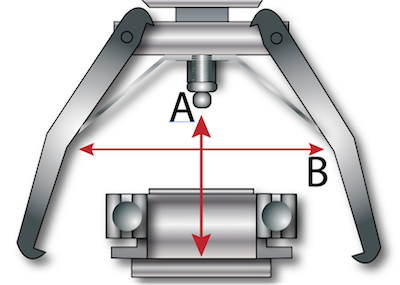
Figure 2: Bearing puller components: arms (A), bearing (B), shaft (C), and forcing screw (D).
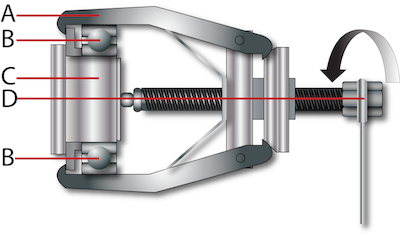
Figure 5: The maximum spread of a bearing puller (B) and the maximum reach (A).
When bearings become seized due to pressure, corrosion, heat, or long-term operation, removing them with hammers or improper tools can damage shafts, housings, or nearby components. Bearing pullers apply controlled extraction force, allowing technicians to remove components safely and efficiently while reducing repair risks and downtime.
The jaws grip the bearing, gear, or pulley securely during the extraction process. Depending on the application, pullers may use two jaws or three jaws to distribute pulling force evenly.
The forcing screw is positioned against the shaft center. As the screw is tightened, it generates pulling force that gradually removes the bearing from its fitted position.
The cross beam connects the jaws and supports force distribution during operation, ensuring stable and balanced extraction.
A bearing puller works by converting rotational force into pulling force. The jaws are first positioned behind the bearing or component. The center screw is then tightened against the shaft. As pressure increases, the puller applies steady extraction force, gradually separating the bearing from the shaft or housing.
First, the puller jaws are adjusted to grip the bearing securely. Second, the forcing screw is aligned with the center of the shaft. Third, the screw is tightened manually, hydraulically, or pneumatically depending on the puller type. Finally, the bearing is extracted smoothly from its mounting position.
External pullers grip the outside of a bearing mounted on a shaft. These are commonly used in wheel hub repair, gearbox service, and industrial machinery maintenance.
Internal pullers are designed for bearings installed inside housings or recesses. The puller expands inside the bearing inner diameter and extracts the bearing outward.
Hydraulic pullers use hydraulic force instead of manual force, making them suitable for heavy-duty applications involving large bearings and high extraction loads.
Mechanical pullers use a manual forcing screw system and are widely used for standard automotive and workshop repair tasks.
Bearing pullers are commonly used in automotive wheel bearing replacement, gearbox repair, axle maintenance, electric motor service, industrial machinery repair, and heavy truck drivetrain maintenance. They are essential tools in professional workshops where safe and damage-free disassembly is required.
Controlled pulling force minimizes the risk of damaging shafts, housings, and bearings during removal.
Specialized pullers simplify difficult removal tasks and significantly reduce repair time.
Using the correct puller reduces the need for hammering or excessive force, improving workshop safety and reducing technician fatigue.
A bearing puller is a specialized tool designed to remove tightly fitted bearings, gears, and pulleys safely and efficiently. By using controlled extraction force through mechanical or hydraulic systems, bearing pullers improve repair efficiency, reduce component damage, and support professional automotive and industrial maintenance operations.